Posts

Popular activities engross the young archaeologists at Fordham

Image
The time flew by this morning at Fordham, a village near Colchester. The chairman of Colchester Archaeological Group (CAG) had arranged archaeological techniques and activities for the young archaeologists,  which had them enthralled for more than three hours. The picture above shows one member recording magnetometry readings. The results were later transferred to a computer which demonstrated some interesting features below the ground. In the background, another group is learning about metal detecting. Near the John Owen Barn, others were washing finds from a nearby Roman site, which included sherds of Roman samian ware and blackened cooking pots, tiny bones and teeth. The chairman of CAG had collected some clay from the Roman site and refined it for making pots, which the young people made with varying degrees of success. Picture below.    

The names of the "Colchester 19" discovered

Image
 It took some looking for, and needed light to illuminate it enough to be seen. Tucked away behind a large screen, in the chancel of St Peter's church on North Hill is a marble memorial to 19 Colchester protestants who died for their faith.    St Peter's church guide books confirm our young archaeologists' club  researches. There were more protestant martyrs burned to death in and from Colchester than anywhere else in England, except for Smithfield, London.         The names of the 19, if I read the memorial correctly are, John Lawrence, Nicholas Chamberlain, Christopher Lyster, John Mace, John Spencer, Simon Joyne, Richard Nichols, John Hammond, William Bongeor, William Pureas, Thomas Beynold, Agnes Silverside, Helen Ewing, Elizabeth Folks, William Munt, John Johnson, Alice Munt, Rose Allen and John Thurston.     Of the ten who were martyred on that fateful day, August 2nd 1557, the memorial describes the places of execution as the cast...

Our project is broadcast and printed

Image
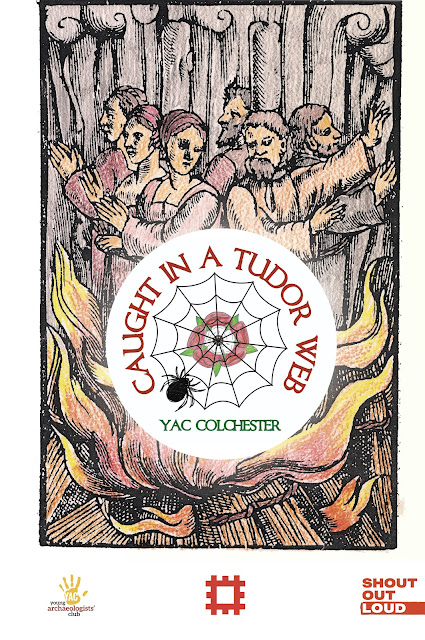
  To promote and support the exploration of our local historic environment, Colchester young archaeologists' club project has been designed and printed. Apart from their map of Essex, for which the young people supplied or suggested new illustrations, they gave instructions to a graphic art firm to map out a walking trail for Colchester town centre. The two sides of the leaflet are illustrated above. Previously the young people had chosen type faces and illustrated the theme, which was originally entitled "Trapped in a Treacherous Tudor Web". Two of their illustrations were selected and amalgamated by a graphic artist, who also simplified the title of the project to be less of a tongue twister. The trail and leaflet has been promoted in the Colchester and District Talking Magazine for May this year, which can be accessed on the website for the Colchester and District Talking Newspaper. 

New trail for Colchester set to be revealed

Image
It has taken six months to devise, and now, a new trail is set to be launched for Colchester town centre. It is part of a scheme to encourage young people to explore their local history. English Heritage devised "shout out loud" and challenged the young archaeologists' clubs throughout the country to deliver a little known or forgotten, "from ordinary to extraordinary" story.    As one of seven clubs whose application was successful, young people in Colchester undertook research, designed eye-catching symbols, coloured pictures, and  used maps to deliver their story in the form of a trail.    With support and advice from the Council of British Archaeology, Colchester Museums and tour guides, Colchester YAC's trail and story will be published online and in leaflet form.    The story encompasses the whole of Essex, with some surprising facts and figures.  It focuses on Colchester, where some ordinary peoples' lives took an extraordinary turn, at a s...

We go beach combing and fossil hunting on the Essex coast

Image
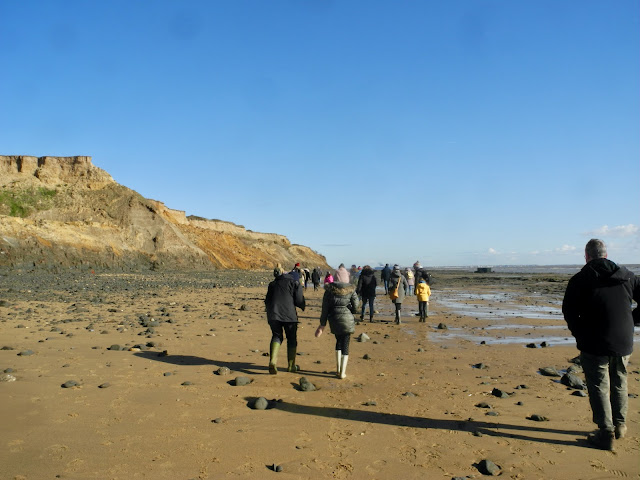
 We planned this in 2019 after a visit to Colchester's Natural History Museum. With an expert from Colchester Museums, four volunteers, eighteen members of the young archaeologist club and their parents met on the Essex coast for beach combing and fossil hunting today. They found sharks teeth, fossilised shells in the slumps of the red crag, fossilised sponge and seeds. One young person broke open some fossilised London clay to reveal imprints of creatures inside and found a lump of coprolite (aka pre-historic poo). Below are some of the things I collected.

Colchester infirmary caught in the "Tudor Web"

Image
The church of St Helen and the Holy Cross. This artist's impression places it in the position it held in Crouch Street, Colchester. I received two items posted through my letterbox this week which relate to our project "caught in a Tudor Web". These included some notes and puzzles on the Reformation from a new ten-year-old member of the club. She had studied the reformation and provided additional information on the religious houses in Colchester, which were closed and demolished in the Tudor period. She writes:- "Crutched Friars or The Hospital of the Holy Cross and St Helen, was founded before 1230 by William de Lanvelli, became a secular hospital or free chapel. Dissolved 1538.   Greyfriars, founded before 1237 by Robert, Lord Fitzwalter, dissolved 1538."   Articles in copies of "The Colchester Archaeologist" confirm the Hospital of the Holy Cross and St Helen, was indeed founded to support the poor and the sick. Those services were lost when it was...

Five religious houses ruined in Tudor Colchester

Image
 Perhaps the most spectacular ruins in Colchester are those of St Botolph's Priory. They are familiar to many who walk to and from Colchester Town railway station or the car park on the site of the former Britannia works. Adam from Colchester YAC writes:- "Saint Botolph's Priory. Founded in 1093. Re-founded 1100. Dissolved 1536. Order Augustinian. Crutched Friars. Founded in 1230 by William de Lanvelli. Re-founded in 1496. Dissolved in 1538. Order:unknown. Greyfriars. Founded in 1237. Dissolved in 1538. Order Franciscan." Greyfriars was the only religious house to be founded within the walled town. Its site is now occupied by a hotel. A wall from the friary and statue niche can be seen in an adjacent car park and the repaired and rebuilt wall of the former friary runs along the east boundary of Castle Park down to the Roman origin wall. The Priory Church of St Botolph's remained to serve as a parish church, but was finally ruined during the Siege of Colchester (16...