Posts

We compare the Egyptian civilisation with life on the British Isles
Image
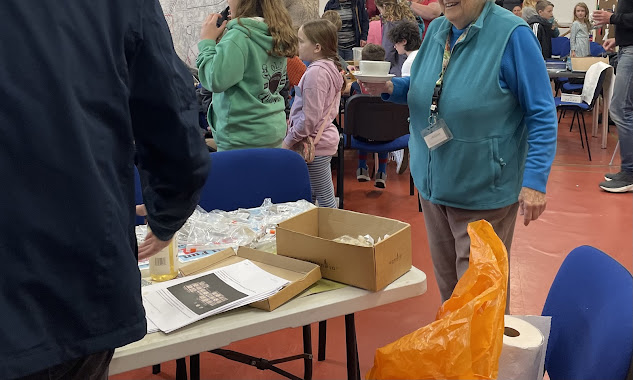
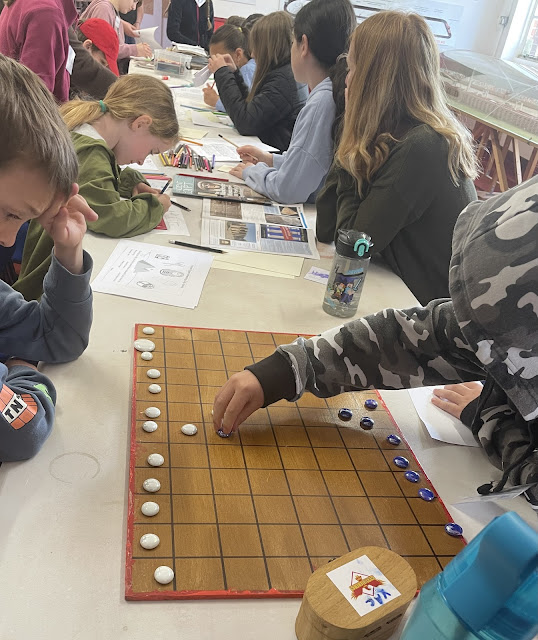
 Our April meeting of the Young Archaeologists' Club started with some interesting finds which members had brought in. One had found a flint scraping tool at Wrabness, which dated from the Stone Age or earlier. We compared life in Ancient Egypt with that in the British Isles, ending with Roman rule in Egypt and the Roman invasion of Britain. This we illustrated with pictures of the doctor or druids grave excavated in Stanway in 1996, which revealed the game interpreted as Aquila. Inspired with pictures of Egyptian artworks and hieroglyphs. The young people then set to and wrote their own names in hieroglyphs, or designed cards, or played Aquila. From the Stone Age, a flint scraping tool, which the young man who found it demonstrated it's serrated edge was still sharp and that it was easy to handle.

Through Stone, Bronze and Iron Ages to Roman Invasion

Image
  The picture shows a young archaeologist making a detailed drawing of a Roman pot sherd, having created a Bronze Age hut from a kit. Young Archaeologists met at Roman Circus House to share their finds and treasures with us this morning. These included a piece of Roman tesserae,  Roman, Greek and English coins, fragments of clay pipes, fossilised creepy crawlies in stones, and a vole skull. They also shared the stories of where the artefacts had been found. Some were handed on from grandparents. The finds were arranged in trays and taken round the room for everyone to look at and handle.     We had a presentation from two volunteers, who told a story depicting Bronze Age life and showed pictures of Stone Age, Bronze Age and Iron Age sites, which included, Skara Brae, Orkney, a Neolithic flint mine at Grimes Graves, Norfolk, and a Bronze Age copper mine at the Great Orme, Llandudno. The YACs were eager to share  their site visits. One had visited the Bronze Age s...

Memorable morning with discoveries and cave paintings

Image
 Invited to bring in their treasures and discoveries to be identified and dated, the response from members of Colchester Young Archaeologists' Club was unexpected. Found near her school, one of our youngest members, had a Roman pot sherd and part of a vitrious enamel pot from centuries later. Another YAC had discovered some fossils from the Suffolk coast at Bawdsey and showed us some interesting finds from an organised archaeological exercise in London. We had an update from the YAC who had discovered the fossil bison bone at East Mersea. She brought in some other bones discovered on the Mersea Island coast, and was able to demonstrate how she had cleaned them up and show us what part of the animal they were from (picture above). None of our members minded handling, identifying and examining these. Our refreshment break was enhanced with a visual presentation of cave paintings from one of our volunteers. Following this, club members created their own cave paintings with pastels and...

We embark on our human life time line

Image
 Colchester Young Archaeologists' Club met in Roman Circus House this month, January, and shared our discoveries and finds. We passed them round for identification and to handle them. We talked about the Mesolithic and Neolithic periods and looked at the short period for the life of man at the top of our "Life on Earth" time line. We looked at pictures of flint axes and arrows discovered at Fingringhoe and Walton and found flint shards and burnt flint among the finds we washed in November. After that we looked at the structures early man built, including Stone Henge, in Lego and round houses, which we made up from kits. Pictures below, henges in Lego and round houses from kits.

A sharp eyed teenager identifies his find

Image
 Some members of Colchester Young Archaeologists' club bring fossils and artefacts they have found to show us when we meet. Our December meeting was no exception.    A 15-year-old brought in more fragments he had picked up for us to identify and to show other members of the club. He was particularly keen to match a fragment of an amphora with one of the exhibits in Roman Circus House.      As it was our last meeting for the year and a festive one, we decorated cards, filled out quiz sheets and played games. One of these, "Will the Barrow Survive",  is a game devised by Mike Corbishly who started Colchester Young Archaeologists' Club in the 1970s, one of the first clubs in the country. We found the game printed in an edition of the "Colchester Archaeologist". We enlarged it and adapted it to be played. It is a difficult game to win, as points are lost when barrows are damaged by various forms of human activity, including erosion, ploughing, infrastructu...

Archaeological skills learned at YAC

Image
For our November meeting at Roman Circus House, our find processing and identification expert instructed us in find washing. We did well in identifying the artefacts we excavated in Fordham, which included a Roman flue tile fragment,  broken Roman tegula, Roman pottery sherds, burnt flint, iron, oyster shells, bone and a nail. We unveiled our "Life on Earth" time line, which took a paper time line from our palaeontology expert as a template, and is illustrated with artwork from club members. Two members brought in fossils and artefacts, which had been found in the River Colne estuary, to be identified. Using the time line illustrated below as an example, club members embarked on illustrating our "Human Life" time line project. We made medieval-style draw-string purses and played the ever-popular game of Aquila, which was devised from a game found in the Romano-British "druid's" grave excavated in Stanway in 1996.     

Detective work on fossils, pot sherds, and volcanic stones

Image
There is a story behind everything and we had some good ones today at Roman Circus House. Once we had all introduced ourselves and described our interest in history and archaeology, we had some unusual fossils, pot sherds and masonry fragments to examine, identify and date. Illustrated here is one of them. Brought in by a new member. She had found it and other animal bones, when she was walking on the beach with her grandparents after shopping earlier this year. The shopping was removed from the bags to accommodate the bones. This one, illustrated, counts as a fossil as it is 120,000 years old. It belonged to a bison and is a metacarpus. It was found on the mud when the tide had receded after very high winds whipped up the high tides and eroded the coast.  Some interesting pieces were brought in by the widow of an archaeologist and historian. She explained that she had discovered them clearing out drawers, cupboards, and jacket and trouser pockets. She has found a plethora of pot s...