Posts

We are fascinated with the enchanting objects Emma chose to show.

Image
 At our November meeting for the Young Archaeologists' Club, members brought in some interesting objects they discovered in their own garden, High Woods Country Park, and Grandma's garden. These included fossils,  an antler, and a leather and metal dagger sheath. Colchester Archaeological Trust archaeologist, Emma, showed us pictures of treasures she had excavated in her work with the trust. Some of them were chance finds, such as the Camulodunum gold coin, which glinted untarnished in the rain sodden ground when she found it. There were chance finds, such as one of the jet bears discovered under a water pipe. These little Roman objects are rare, but three have been unearthed in Colchester so far. Apart from being a professional archeologist, Emma is an artist and illustrator. Some of the pieces she chose to show us were exquisitely fine work, such as the tiny fly image carved into a set stone and the Medusa hair pin head, which had probably kept an elaborate Roman hair do in ...

We enjoy the romance of the Silk Road and appreciate clues to the past

Image
 This month, it is 13 years since we restarted Colchester Young Archaeologists' Club and one of the volunteers who helped to restart the club, joined us today, with her daughter as a new member. One of our volunteers shared the leader training day information and activities on the legendary Silk Road, which brought exotic fabrics and spices from east to west. Above are two of the activities she organised, making colourful pagodas and origami swans. The clothing the young archaeologist wears tells a story too. It's only half way to being an antique, but nevertheless commemorates a historic tour by a legendary band. The Roman fragments below were picked up by a sixteen-year-old who is studying at the Sixth Form College. He picked up the fragment of Roman Samian Ware off the ground by a tree outside the Firstsite art gallery in the centre of Colchester. This together with the prehistoric flints found by Colchester Archaeological Group at Fordham, proves it is still possible to pic...

Young archaeologists explore a Roman site near Colchester

Image
  This morning Colchester's young archaeologists honed their excavating skills at an extensive site in the village of Fordham, which Colchester Archaeological Group (CAG) has been investigating for more than ten years. Colchester Young Archaeologists' Club leaders brought trowels and kneelers to the site, which CAG supplemented with further trowels and kneelers, buckets, shovels and sieves. Among the finds were Roman brick and tile fragments a possible flint scraping tool, animal bones, and fossils.      The site director gave health and safety instructions before the group made their way to the current part of the site being investigated. Changes in the colour of the soil gave clues to the possible presence of Roman wall plaster and mortar and there was an abundance of Roman brick and tile fragments. The actual function of the site is a conundrum. CAG archaeologists on the Roman site have discovered many large loose tesserae pieces, brick and tile fragments, a water...

Colchester YAC go beach combing and fossil hunting on the Essex Coast

Image
  We had a warm sunny day for our trip to the coast. The time on the beach went all too quickly. Evidence of the wooded banks of the confluence of the Thames, Medway and proto Rhine rivers at this particular spot was noted from the amount of fossilised bark, which was collected in quantity, especially when the young people realised that millions of years ago,  long necked dinosaurs nibbled on the trees. Rising sea levels wiped out the land-based dinosaurs, but jurassic fossils have been found on this coast, swept down the rivers from the midlands. We founds fossilised whale bones and sharks teeth, fish eggs, and freshwater snails from the river areas. This year we hired a room in the visitor centre, where YAC volunteers prepared refreshments and our expert could examine and help us date our finds. One young man had brought in a worked flint used by early man and found on a previous trip he made further along the coast. On our visit to Fordham last month, the chair of Colcheste...

Young Archaeologists explore St Botolph's Priory

Image
 Colchester Young Archaeologists' Club met in St Botolph's church hall, Colchester, today. Four young people had brought in artefacts they had discovered to be identified, dated, and handled. Our teenage mudlarker brought in some Roman replicas and explained their use, and how they were made, to the others. One of our volunteers had studied glass blowing, and was able to explain how the Roman replica glass was made. More difficult to date were the sharks teeth and belemnite found on the Essex Coast, which could have been between 250,000,000 to circa 66,000,000 years old. The young people found the quiz, which had been devised for them, was challenging. They used their imagination to work out what the duties of the sacrist were and how a "necessarium" in a monastery was used. Other activities included monastery-style illumination techniques and our popular game of Aquila. Two groups took a tour of the priory church remains and discovered fragments of the medieval tiled...

Archaeological techniques learned at Fordham

Image
Metal detecting in Fordham revealed a surprising number of objects.  When Colchester Young Archaeologists' Club visited Fordham, they found out the village had been occupied since the Stone Age. They learned that ring ditches had been identified from satellite images, many flints had been discovered, together with a plethora of artefacts from more recent centuries. They learned metal detecting techniques and discovered a considerable number of metal objects, considering what a small site it was. They were instructed in magnetometry to discover more about changes to the environment and occupation of the village. They solved some archaeological puzzles and identified some animal bones from a bag. One YAC brought in the c. 300,000-year-old fossil bison bone she discovered on East Mersea beach to show our host, the chairman of Colchester Archaeological Group. Coastal erosion from exceptionally high tides had dislodged the fossil from the cliffs and washed it on to the estuary mud. Arch...

We compare the Egyptian civilisation with life on the British Isles

Image
 Our April meeting of the Young Archaeologists' Club started with some interesting finds which members had brought in. One had found a flint scraping tool at Wrabness, which dated from the Stone Age or earlier. We compared life in Ancient Egypt with that in the British Isles, ending with Roman rule in Egypt and the Roman invasion of Britain. This we illustrated with pictures of the doctor or druids grave excavated in Stanway in 1996, which revealed the game interpreted as Aquila. Inspired with pictures of Egyptian artworks and hieroglyphs. The young people then set to and wrote their own names in hieroglyphs, or designed cards, or played Aquila. From the Stone Age, a flint scraping tool, which the young man who found it demonstrated it's serrated edge was still sharp and that it was easy to handle.

Through Stone, Bronze and Iron Ages to Roman Invasion

Image
  The picture shows a young archaeologist making a detailed drawing of a Roman pot sherd, having created a Bronze Age hut from a kit. Young Archaeologists met at Roman Circus House to share their finds and treasures with us this morning. These included a piece of Roman tesserae,  Roman, Greek and English coins, fragments of clay pipes, fossilised creepy crawlies in stones, and a vole skull. They also shared the stories of where the artefacts had been found. Some were handed on from grandparents. The finds were arranged in trays and taken round the room for everyone to look at and handle.     We had a presentation from two volunteers, who told a story depicting Bronze Age life and showed pictures of Stone Age, Bronze Age and Iron Age sites, which included, Skara Brae, Orkney, a Neolithic flint mine at Grimes Graves, Norfolk, and a Bronze Age copper mine at the Great Orme, Llandudno. The YACs were eager to share  their site visits. One had visited the Bronze Age s...

Memorable morning with discoveries and cave paintings

Image
 Invited to bring in their treasures and discoveries to be identified and dated, the response from members of Colchester Young Archaeologists' Club was unexpected. Found near her school, one of our youngest members, had a Roman pot sherd and part of a vitrious enamel pot from centuries later. Another YAC had discovered some fossils from the Suffolk coast at Bawdsey and showed us some interesting finds from an organised archaeological exercise in London. We had an update from the YAC who had discovered the fossil bison bone at East Mersea. She brought in some other bones discovered on the Mersea Island coast, and was able to demonstrate how she had cleaned them up and show us what part of the animal they were from (picture above). None of our members minded handling, identifying and examining these. Our refreshment break was enhanced with a visual presentation of cave paintings from one of our volunteers. Following this, club members created their own cave paintings with pastels and...

We embark on our human life time line

Image
 Colchester Young Archaeologists' Club met in Roman Circus House this month, January, and shared our discoveries and finds. We passed them round for identification and to handle them. We talked about the Mesolithic and Neolithic periods and looked at the short period for the life of man at the top of our "Life on Earth" time line. We looked at pictures of flint axes and arrows discovered at Fingringhoe and Walton and found flint shards and burnt flint among the finds we washed in November. After that we looked at the structures early man built, including Stone Henge, in Lego and round houses, which we made up from kits. Pictures below, henges in Lego and round houses from kits.

A sharp eyed teenager identifies his find

Image
 Some members of Colchester Young Archaeologists' club bring fossils and artefacts they have found to show us when we meet. Our December meeting was no exception.    A 15-year-old brought in more fragments he had picked up for us to identify and to show other members of the club. He was particularly keen to match a fragment of an amphora with one of the exhibits in Roman Circus House.      As it was our last meeting for the year and a festive one, we decorated cards, filled out quiz sheets and played games. One of these, "Will the Barrow Survive",  is a game devised by Mike Corbishly who started Colchester Young Archaeologists' Club in the 1970s, one of the first clubs in the country. We found the game printed in an edition of the "Colchester Archaeologist". We enlarged it and adapted it to be played. It is a difficult game to win, as points are lost when barrows are damaged by various forms of human activity, including erosion, ploughing, infrastructu...

Archaeological skills learned at YAC

Image
For our November meeting at Roman Circus House, our find processing and identification expert instructed us in find washing. We did well in identifying the artefacts we excavated in Fordham, which included a Roman flue tile fragment,  broken Roman tegula, Roman pottery sherds, burnt flint, iron, oyster shells, bone and a nail. We unveiled our "Life on Earth" time line, which took a paper time line from our palaeontology expert as a template, and is illustrated with artwork from club members. Two members brought in fossils and artefacts, which had been found in the River Colne estuary, to be identified. Using the time line illustrated below as an example, club members embarked on illustrating our "Human Life" time line project. We made medieval-style draw-string purses and played the ever-popular game of Aquila, which was devised from a game found in the Romano-British "druid's" grave excavated in Stanway in 1996.     

Detective work on fossils, pot sherds, and volcanic stones

Image
There is a story behind everything and we had some good ones today at Roman Circus House. Once we had all introduced ourselves and described our interest in history and archaeology, we had some unusual fossils, pot sherds and masonry fragments to examine, identify and date. Illustrated here is one of them. Brought in by a new member. She had found it and other animal bones, when she was walking on the beach with her grandparents after shopping earlier this year. The shopping was removed from the bags to accommodate the bones. This one, illustrated, counts as a fossil as it is 120,000 years old. It belonged to a bison and is a metacarpus. It was found on the mud when the tide had receded after very high winds whipped up the high tides and eroded the coast.  Some interesting pieces were brought in by the widow of an archaeologist and historian. She explained that she had discovered them clearing out drawers, cupboards, and jacket and trouser pockets. She has found a plethora of pot s...

Colchester YACs go on site at Fordham

Image
 Armed with their own trowels and kneelers, Colchester Young Archaeologists' Club found Roman brick and tile fragments and pottery sherds on an extensive Roman site in farmland in the village of Fordham. There are views from the site across the countryside to the City of Colchester. Colchester Archaeological Group has been digging on the site for ten years now and it keeps us all guessing as to the extent of it and its purpose. Roman dwelling was our first thought. or perhaps, being a three mile walk from Colchester, it was an inn. Masses of Roman tesserae have been excavated, many bone hair pins, an elaborately carved bone box. Archaeologists found evidence of a water feature/fountain The site is likely to continue well beyond the boundary (above). They put the spoil in buckets and learned how to sift it, from the manager of the site. They washed what they had found, after being alerted to bring old toothbrushes to wash out the grooves. One young man, inadvertently dropped the pie...

We explore a Roman site deep in the Essex countryside

Image
 Our host today was interested in archaeology from the age of 4. His father had been walking in one of their fields, when he picked up a Roman tile with a dog paw print on it. On investigation, and several years and unexpected pot and sink holes later, father and son discovered there had been an extensive Roman settlement on the site. What they discovered indicated the sophistication of life nearly two thousand years ago. Our group were good at identifying the artefacts on display and answering the questions posed to them in the museum. In the picture, above, the young archaeologists are standing on the site of a large Roman kitchen, identified because of the amount of pot sherds and pans discovered. One of them, a whole pot at a lower level, had been used under the floor in the northern corner of the kitchen to keep foodstuffs cool. A Roman "Travelodge" someone remarked. Evidence showed the local community made almost everything they needed from raw materials which were  to ...

We dug it up!

Image
 "We dug it up!" said one of the young archaeologists excitedly. She ran in with a large rusty metal object, as yet unidentified, which had given the metal detectors a very strong signal. Colchester Young Archaeologists met in the village of Fordham to learn how to identify bones, re-assemble pot shards into a whole, wash and sort finds from the nearby Colchester Archaeological Group dig and the ever popular metal detecting. Unlike our previous visits, the weather was unpredictable and as the large metal object was unearthed we all went under cover. Finds washed included some interesting pot shards and a small serrated edged flint tool. The bones identified were from the nearby dig and were an indication of the  animals, domestic, farm and wild, which were on and around the site in the Roman period. Below is a picture of the find washing activity.

The receding tide on the Essex Coast reveals fossils

Image
  Colchester Young Archaeologists' Club explore the beach as the tide recedes. Before we ventured on to the beach to see what the receding tide had exposed, our expert explained we were exploring a site of special scientific interest. He explained that this part of the English coast had once been part of the continent and, apart from fossil shells exposed in the eroding Red Crag, the tide washed objects in from the near continent and further afield. The children had brought stones and fossils for him to identify and we looked round the visitor centre before we set off. The ebbing tide had exposed the three coastal war time defences, seen in the picture. The massive cranes of Felixstowe deep water container dock can be seen in the distance. Our expert was soon in demand to identify the objects the children had picked up. As soon as they realised his skills, two students who were taking erosion measurements brought things they had discovered to identify. Once free from identifying ob...

We explore St Botolph's priory and play games from the ancient world

Image
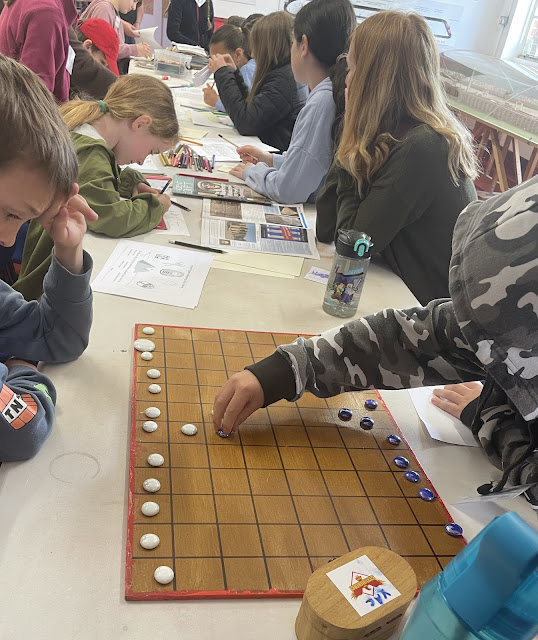
 Colchester Young Archaeologists' Club explored the remains of St Botolph's Priory church today and then discovered the footprint of the lost columns, transepts and sanctuary which, since Colchester Archaeological Trust's excavation of the site, are mapped out in concrete and stones. They chose to find spots on the sites of the columns to stand to indicate where they are. We went into the church hall in a shower for activities, which included Aquila. The devisor of this Romano/British game was on hand to explain the strategy. The prototype is from the first century AD and was discovered by Colchester Archaeological Trust in 1996 in the doctor/druid's grave the trust excavated in Stanway, Colchester. The grave is now replicated in Colchester Castle Museum. A YAC volunteer brought in a version of "the oldest game in the world." Played in the past 6,000 years. He said anything could be used, shells, seeds or pebbles in grooves made in sand or ground. Members of t...

We take making clothes back to basics!

Image
Jack cards the wool for Esther to spin it At Colchester's Young Archaeologists' club March meeting we looked at the fibres and fleeces which  even Stone Age communities used to clothe themselves. Archaeologists have discovered woven cloth which dates from the Stone Age. These were made from the fibres found between the bark and wood of trees. Other raw materials available to our ancestors is wild cotton, flax for linen, nettle fibre and the favourite for the British Isles, fleeces from sheep  were spun and woven into cloth.      Thanks to a generous donation of fleeces, wool combs and spindles a team of Jack, who combed the raw wool and Esther, who became a dab hand at spinning it, didn't have enough time to weave the impressive amount of  thread they produced between them.     Others learned they could produce clothes by knitting or crocheting the finished thread or produce a trim or tie with a lucet.      We tried weaving techniqu...

We look back in time with flints and fossils

Image
 Colchester Young Archaeologists' Club looked back in time today. We  explored the ancient art of flint napping  techniques. It was done safely with soap and wooden knives. We were recommended to use wooden knives on the imperial leather brand of soap. It has the right sort of consistency to be worked like flint on flint. As the young people napped the 'flints' the fragrance of the soap filled the room. When they drew flints,  the standard of drawing was exceptional. Some young people were fascinated with our collection of fossils and puzzled through the fossil dating quiz, working out which species were likely to be tens and hundreds of million years old. We had some new members join us and they were introduced to the ever-popular game of Aquila.